
Rare earth elements are a key raw material for modern industry – but Germany faces a major challenge in this area. While geological deposits exist (e.g., in the Erzgebirge), they are currently hardly exploited economically. Reasons for this include stringent environmental regulations, complex extraction processes, and high costs.
The result: Germany is heavily dependent on imports – especially from China. This dependence is increasingly becoming a risk for industry and small and medium-sized enterprises (SMEs).
Our explaination why stable supply chains are crucial today: The Interview:
The problem is also clearly reflected in the media – Click here to watch the NDR TV report.
What Are Rare Earth Elements?
Strictly speaking, not all critical high-tech metals belong to the "classic" rare earth elements. In practice, however, one often speaks of a broader group of critical metals that are indispensable for modern technologies.
This includes materials such as:
- Gallium
- Indium
- Tantalum
- Tellurium
- Molybdenum
- Rhenium
These elements possess unique properties – such as high heat resistance, conductivity, or magnetic strength.
Are Rare Earths Actually Rare?
Despite their name, rare earth elements are not particularly rare in the Earth’s crust..
The challenge lies in:
- to find them in economically viable concentrations
- to extract and process them in a time-consuming process
Therefore, they are strategically valuable and sometimes difficult to obtain.
Where Are Rare Earths Found?
The main producing countries are:
- China (dominant market leader)
- USA
- Australia
- Russia
Germany currently plays only a minor role in extraction but is working toward securing access to critical raw materials.
Critical Raw Materials at MCC
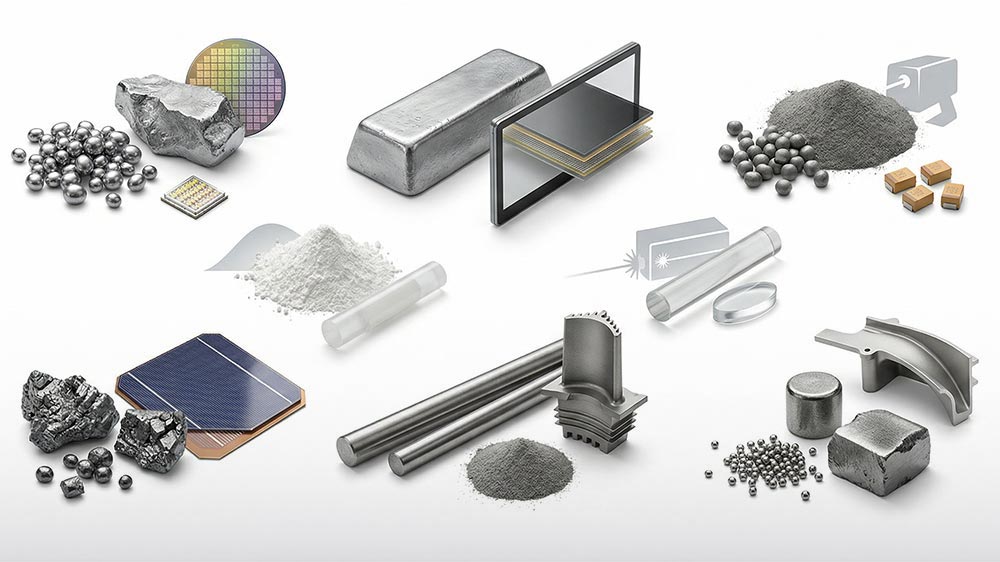
MCC provides access to key high-tech metals for industrial applications:
- Gallium – essential for semiconductors & LEDs
- Indium – important for displays & touchscreens
- Tantalum – indispensable for electronics & capacitors
- Yttrium Oxide – for ceramics, lasers & high-tech applications
- Tellurium – relevant for solar technology
- Molybdenum – high-temperature resistant alloys
- Rhenium – Key material for aviation & turbines
Look for more in our portfolio: RARE EARTHS
What are rare earth elements used for?
Rare earths and critical metals are the basis of many future technologies:
E-mobility & energy transition
- Electric motors
- Batteries
- Wind turbines
Electronics & Digitization
- Smartphones
- Displays
- Semiconductor
Industry & Aviation
- High-performance alloys
- Turbines
- Special components
Metals such as tantalum, rhenium, or molybdenum are indispensable here because they can withstand extreme conditions.
Buying Rare Earths – What Companies Should Consider
When sourcing critical raw materials, companies should focus on:
- supply reliability
- material quality & purity
- trusted partners
MCC supports businesses with secure sourcing solutions:
Explore our portfolio RARE EARTHS