
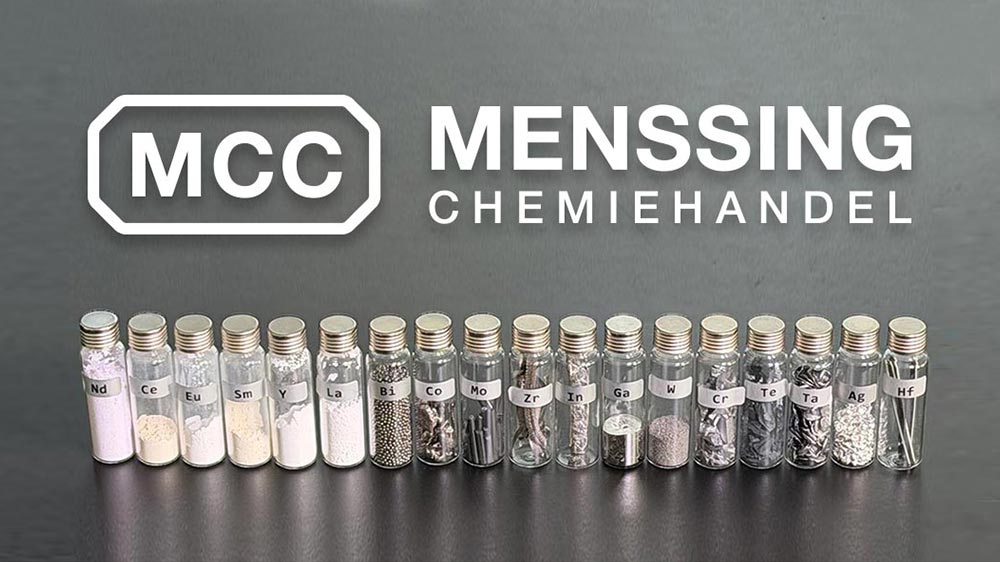
Interview with Jan Menssing, Managing Director of MCC - Menssing Chemiehandel & Consultants GmbH
The global rare earth markets are increasingly under geopolitical pressure. Rising demand in China, more selective export policies, and structural dependencies are presenting industrial companies with new challenges. In this interview, Jan Menssing, Managing Director of MCC - Menssing Chemiehandel & Consultants GmbH, explains why the market has fundamentally changed and what role distributors play today in securing critical raw materials.
The rare earth market is no longer a typical raw materials market
Mr. Menssing, how do you assess the current market situation for rare earths?
Looking at the rare earth market today, we no longer see a classic raw materials market, but rather a strategically driven bottleneck. Availability is increasingly determined not only by supply and demand, but also by industrial policy decisions. China is strategically leveraging its strong position along the entire value chain—both with the raw materials themselves and with processed upstream and downstream products. For internationally operating industries, supply chain resilience is clearly moving into focus.
Rising domestic demand in China increases pressure on global supply chains
What structural changes are you currently observing?
Domestic demand in China has risen significantly in recent years, while export policies have become more selective. For many industries, this means growing uncertainty regarding the long-term supply of critical materials. Particularly for magnetic materials and processed products, there remains a high short-term dependence on Chinese supply chains.
Lessons from the 2010 rare earth crisis only partially implemented
In your view, were the right conclusions drawn?
Unfortunately, only partially. After the 2010 crisis, the situation normalized relatively quickly, which eased the pressure to act. The diversification towards the USA or Australia that was discussed at the time was not consistently implemented – primarily due to higher costs outside of China. Today, we are seeing once again how structural dependencies can lead to supply risks.
International Raw Materials Strategies: Japan and South Korea as Role Models
How do you assess the international approaches?
Countries like Japan, with the Japan Organization for Metals and Energy Security (JOGMEC), and South Korea, with the Korea Resources Corporation (KORES), established state-run instruments for securing raw materials early on. These models actively support companies in diversifying and reduce supply risks. A comparably long-term raw materials architecture is still only partially present in Germany.
MCC's Role: Proactive Supply Security for Customers
What does this development mean specifically for MCC?
For us as a distributor, a growing part of the supply security function is shifting into our responsibility. Our customers expect high supply stability—and this is precisely where we come in. We closely monitor markets and countries of origin and build up inventories early to ensure delivery capability even in volatile market phases.
Higher Working Capital as the Price of Resilience
What are the economic implications of this strategy?
Proactive inventory management leads to a significantly increased need for working capital and longer capital commitment periods, especially for high-priced materials. Distributors are thus increasingly assuming a crucial resilience function within the supply chain—often requiring significant upfront financial investment.
Diversification is possible - but economically demanding
How realistic is true diversification?
Technically, diversification is certainly possible—through new mines, recycling, or European projects. However, many of these approaches are still under economic pressure. The decisive factor will be how industry, financing partners, and policymakers collaborate in the future to make alternative supply chains sustainably viable.
Courage and innovation are needed now
Your conclusion, Mr. Menssing?
Germany has always been particularly strong when courage and innovation have converged. We need precisely this determination again today. Resilient supply chains are not created by waiting, but by early investments, strategic partnerships, and a willingness to explore new paths.
About MCC - Menssing Chemiehandel & Consultants GmbH
MCC supports industrial companies in the strategic procurement and hedging of critical raw materials and specialty chemicals. The focus is on market transparency, resilient supply chains and proactive inventory strategies.
The interview can also be found here in the NDR Mediathek.